




























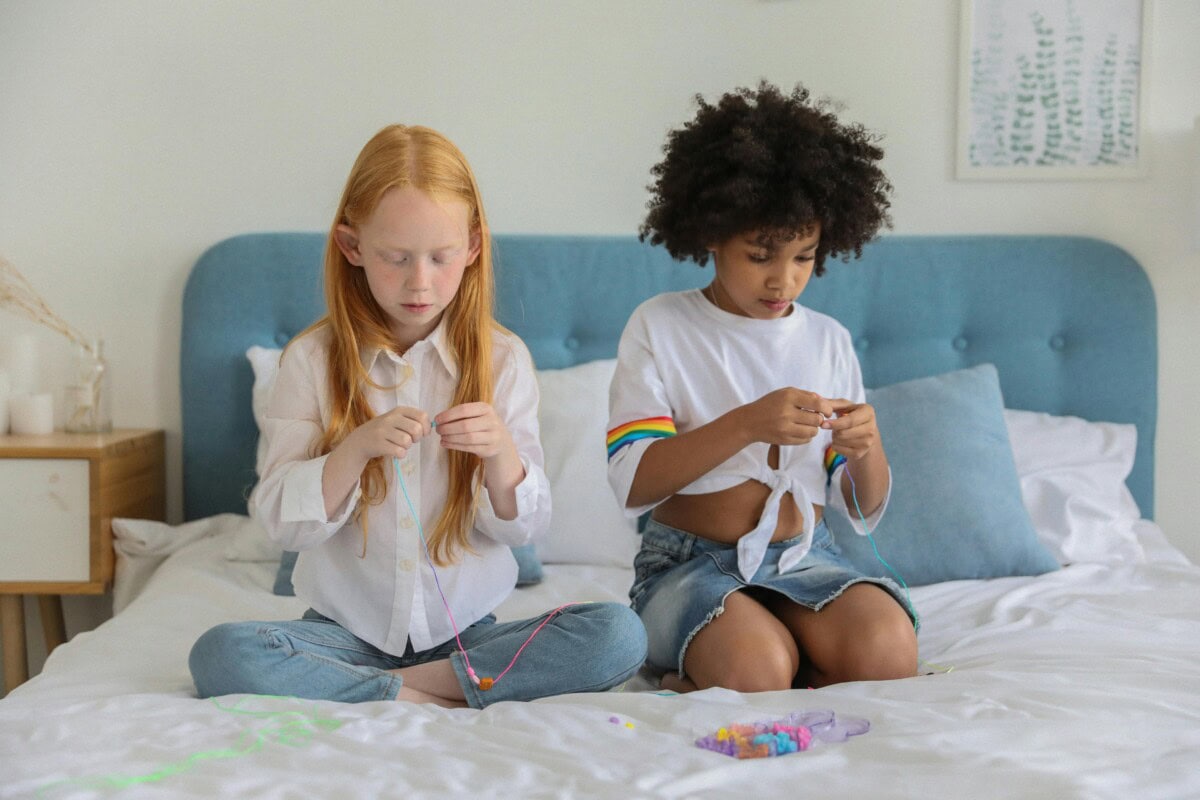
There’s something special about creating matching friendship bracelets with someone close to your heart. Whether it’s for summer camp nostalgia, a birthday surprise, or just because, these handmade tokens carry meaning that store-bought jewelry simply can’t match. The best part? Answering the question “how do I make a friendship bracelet,” isn’t nearly as complicated as it looks.
This guide walks through everything needed to create stunning DIY friendship bracelets, from mastering the four basic friendship bracelet knots to designing perfectly coordinated matching sets. By the end, anyone can confidently tie beautiful bracelets that friends and family will treasure. Ready to make your first matching pair? Let’s dive in.
What You Need: String, Thread, and Bead Essentials
Before jumping into bracelet making, gathering the right supplies makes all the difference. The foundation of any friendship bracelet starts with choosing the right string for friendship bracelets.
String and thread options:
- Embroidery floss – The classic choice with six threads per strand, affordable and available in countless friendship bracelet colors
- Yarn – Perfect for chunkier, bohemian-style bracelets and easier for preschool-aged crafters to grip
- Elastic string – Beginner-friendly option that eliminates clasps and creates stretch bracelets
- Thread – Various types work depending on desired thickness and texture
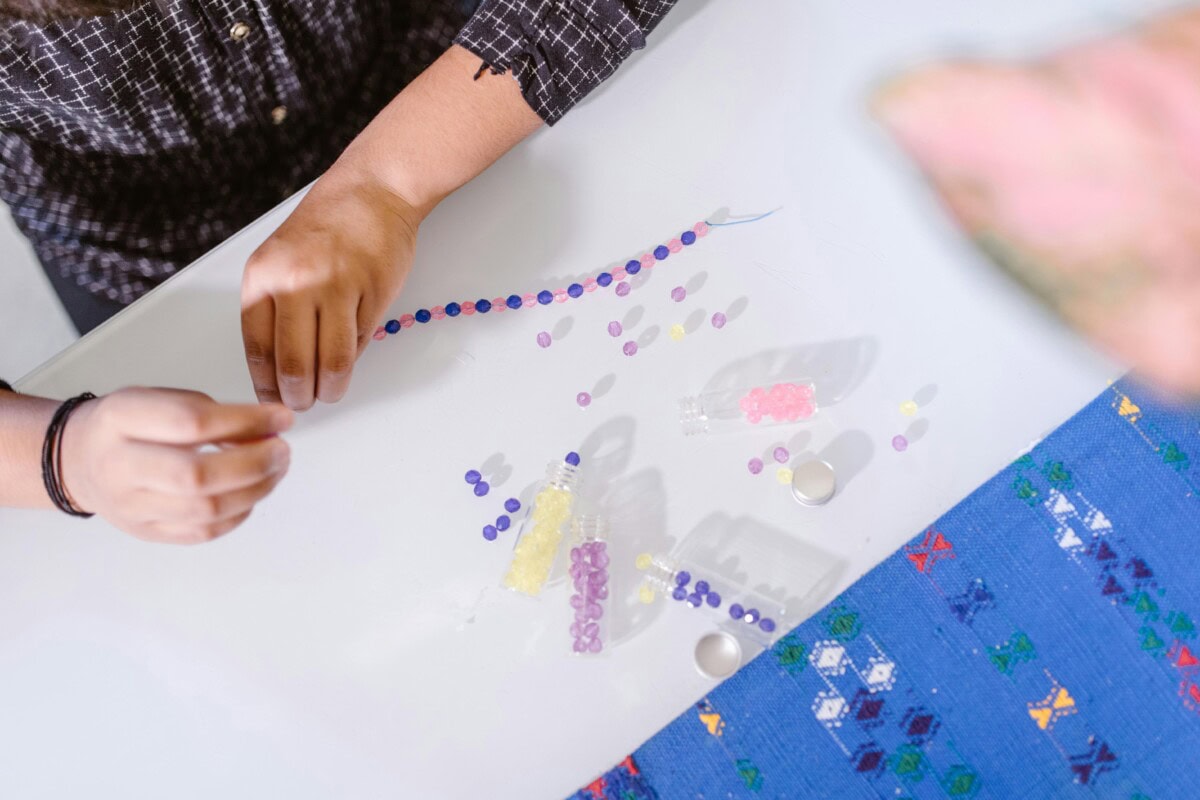
When it comes to beads, the options are endless. Pony beads are perfect for kids and bold, colorful designs. Pearl beads add elegance to more sophisticated patterns. Letter beads allow for personalization—spelling out names, initials, or messages like “BEST” on one bracelet and “FRIEND” on its matching partner.
Essential bead types:
- Pony beads – Large, easy to thread, colorful
- Pearl beads – Elegant and sophisticated
- Letter beads – Spell names or messages
- Seed beads – Tiny accent beads for texture
Building a starter kit doesn’t require breaking the bank. Pick up a variety pack of embroidery floss in different colors of string, some favorite beads, scissors, tape, and a clipboard or safety pin to secure work in progress.
The Four Basic Friendship Bracelet Knots
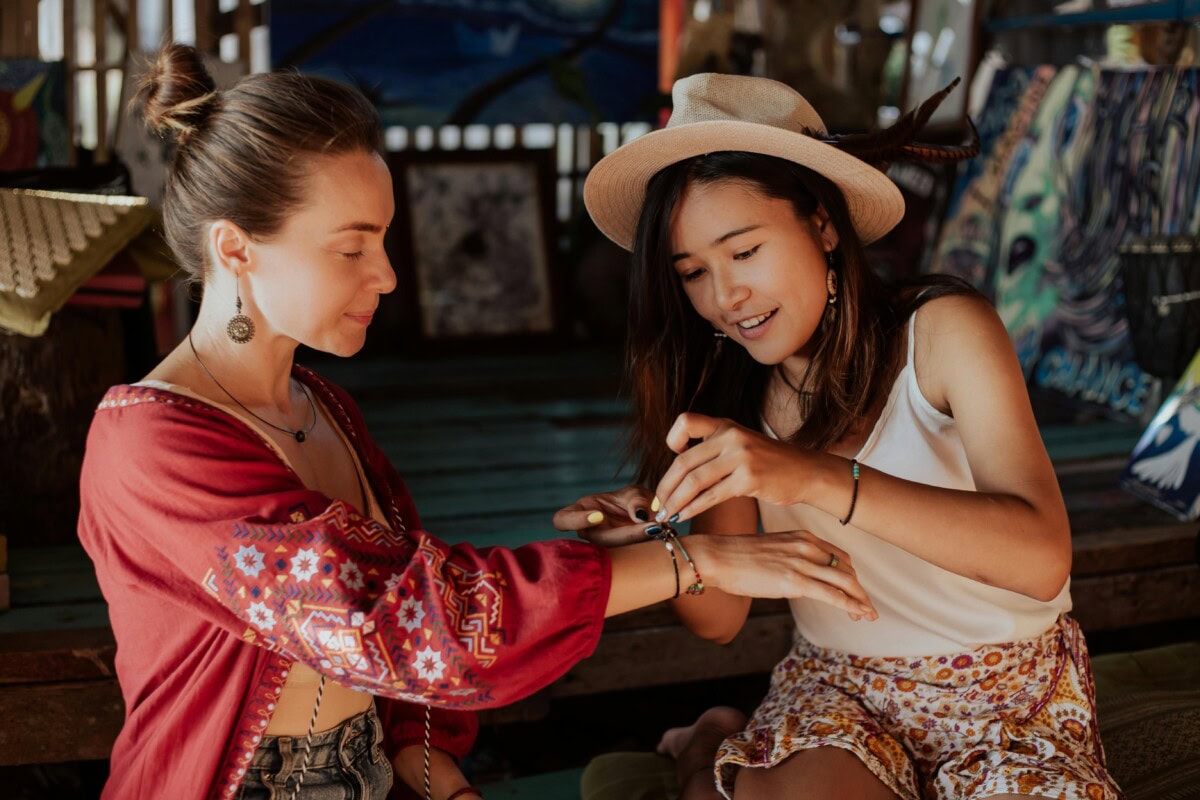
Understanding friendship bracelet knots forms the foundation of every pattern out there. There are four basic friendship bracelet knots that create all those intricate designs seen online: the forward knot, the backward knot, the forward-backward knot, and the backward-forward knot.
The forward knot:
- Moves from left to right
- The string on the left makes a “4” shape over the strand next to it
- Pull through the loop and tighten
- Make a forward knot twice on the same strand to complete it (that’s why patterns call for two knots or 2 knots)
The backward knot:
- Works opposite to forward knot, moving right to left
- The right string creates a backwards “4” over its neighbor
- Essential for creating pattern symmetry
Combination knots:
- Forward-backward and backward-forward knots combine these movements
- Create directional changes that form chevron patterns, diamonds, and geometric shapes
- Master these and any pattern becomes possible
While it might feel awkward at first, muscle memory kicks in quickly. Most bracelet makers find themselves tying these basic knots without even thinking after just one or two practice sessions.
Basic Knots: Mastering Your Technique
Consistency is key when learning to tie a knot properly. The most common beginner mistake? Pulling too tight or too loose. Each knot should have the same tension to create an even, professional-looking bracelet.
Tips for consistent tension:
- Think “Goldilocks” – not too tight, not too loose, just right
- Push each knot up snugly against the previous row before moving to next strand
- This prevents gaps in the weave and creates uniform appearance
- On candy stripe or diagonal patterns, the rhythm becomes almost meditative
Another technique worth mastering early: how to knot around another strand without twisting it. The working strand should wrap smoothly around the stationary one. If the bracelet starts looking twisted or bunched, it’s usually because the base strands are rotating during knotting. Keeping the foundation strings flat and parallel solves this issue immediately.
How to Read Friendship Bracelet Patterns

Learning to read friendship bracelet patterns opens up a world of design possibilities. Most patterns use a grid system where each row represents a line of knots across the bracelet, and each square or symbol indicates which knot to make.
Pattern symbols typically include:
- Forward knots – Arrows pointing right or forward slashes
- Backward knots – Arrows pointing left or backward slashes
- Forward-backward knots – Arrows with curves
- Backward-forward knots – Opposite curved arrows
- Different colors of thread represented by colored squares or letters
The key to read a friendship bracelet pattern successfully is starting from the top and working row by row. Each row shows which strings to use and which direction to knot. Some patterns include numbers along the sides indicating string positions, which helps track progress through more complex designs.
When first starting out, choose patterns with clear color coding and simple repeats. The diamond friendship bracelet pattern, for instance, uses symmetrical knots that make it easier to spot mistakes. Free pattern resources abound online, from dedicated bracelet maker websites to social media accounts sharing patterns and designs. Many also offer a video tutorial alongside written instructions, which can be incredibly helpful for visual learners trying to read a friendship bracelet pattern for the first time.
Friendship Bracelet Colors: Coordinating Matching Sets
Choosing friendship bracelet colors for matching bracelets requires a bit of strategy. For identical twin bracelets, simply use the exact same color combination in both. But there’s something extra special about complementary matching designs that feel coordinated without being carbon copies.
Consider these coordination approaches:
Color coordination strategies:
- Reversed dominance – Same colors but in reversed order (blue dominant with pink accents vs. pink dominant with blue accents)
- Mirror-image placement – Pattern flows outward from center in opposite directions
- Seasonal themes – Ocean blues and sandy beiges for summer camp, burgundy and orange for autumn
- Holiday themes – Red and green, silver and blue for winter celebrations
- Personal favorites – Use each person’s favorite color in their partner’s bracelet for extra thoughtfulness
Personalization takes color selection even further. Consider the meaning behind color choices—best friends might choose each other’s birth month colors, while siblings could incorporate family colors or school pride shades.
How to Make a Friendship Bracelet: Step-by-Step Tutorial
Time for the main event! Making a bracelet from start to finish becomes straightforward once the basic process is understood.
Complete step-by-step process:
- Measure and cut strands – Cut each strand about four times the length of the finished bracelet (for a 7-inch bracelet, cut strands 28-30 inches long)
- Tie foundation knot – Gather all strands and tie an overhand knot about 2 inches from one end
- Secure your work – Tape knotted end to table, clip to clipboard, or pin to cushion
- Follow your pattern – Start making knots row by row, ensuring proper tension and placement
- Build the design – The middle of the bracelet showcases the main pattern
- Continue to desired length – Work until bracelet wraps comfortably around wrist with room for tying
The rhythm becomes almost addictive: knot, push up, switch strands, knot again. The magic of friendship bracelet patterns reveals itself as the design comes to life from simple string and basic knots. Keep going until reaching the desired length, usually when it’s long enough to wrap comfortably around the wrist with a bit of room for tying.
How to Tie and Start Your Bracelet
The beginning of any bracelet sets up everything that follows. Two popular starting methods each have their advantages.
Starting methods:
- Overhand knot method – Straightforward, works for virtually any pattern, gather all strands and tie together leaving a tail for finishing
- Loop start method – Creates polished look with built-in closure, fold all strands in half at midpoint, tie a knot at the fold leaving a loop at top, requires cutting strands twice as long initially
Securing the workspace:
- Tape to flat surface (desk, table, or board)
- Clip to clipboard or book
- Pin to cushion or leg of jeans while sitting
- Use dedicated bracelet maker tool with slots to organize strands
Whatever method chosen, make sure the setup keeps strands organized and separated. Tangled strings are the enemy of a smooth crafting session. The loop start is particularly clever because that loop will eventually slip over a knot at the end to secure the finished bracelet around the wrist.
Easy Friendship Bracelet Patterns for Beginners
Starting with simple patterns builds confidence and teaches fundamental techniques without overwhelming frustration.
Beginner-friendly patterns:
- Candy stripe pattern – Classic first project creating diagonal stripes using only forward knots, perfect for practicing consistent tension
- Basic three-strand braid – Requires no knotting at all, choose three different colors and braid tightly, add beads at intervals for visual interest
- Simple striped pattern – Alternates colors in horizontal bands, uses backward knots exclusively working right to left
- Easy friendship bracelet variations – Bold graphic looks that prove beautiful doesn’t mean complicated
These easy friendship bracelet ideas prove that simple designs make the most impact, especially when creating matching sets for friends or family. This technique works especially well with yarn or thicker thread and creates fun and easy matching bracelets in under 15 minutes.
The Chevron Pattern: A Matching Bracelet Classic
The chevron friendship bracelet stands as one of the most recognizable and beloved designs in the bracelet-making world. Its distinctive V-shaped arrows pointing toward the center make it ideal for coordinated pairs.
Why chevron works for matching sets:
- Two people can sport matching chevron bracelets that look cohesive without being identical
- Simply switch up the color order for coordination with individuality
- Uses both forward and backward knots for skill building
Step-by-step chevron instructions:
- Arrange strings symmetrically (mirror colors from center outward)
- Start with leftmost strand, make forward knots all the way to center
- Start with rightmost strand, make backward knots to center
- Tie the two center strands together
- Repeat with the next outermost strands
The beauty of the chevron lies in its versatility. Use two colors for a bold, high-contrast look. Add three or four colors for a rainbow effect. Create matching bracelets by keeping the same color sequence but reversing the starting position—one bracelet begins with blue on the outside while its match starts with pink.
Friendship Bracelet Patterns: Popular Design Ideas
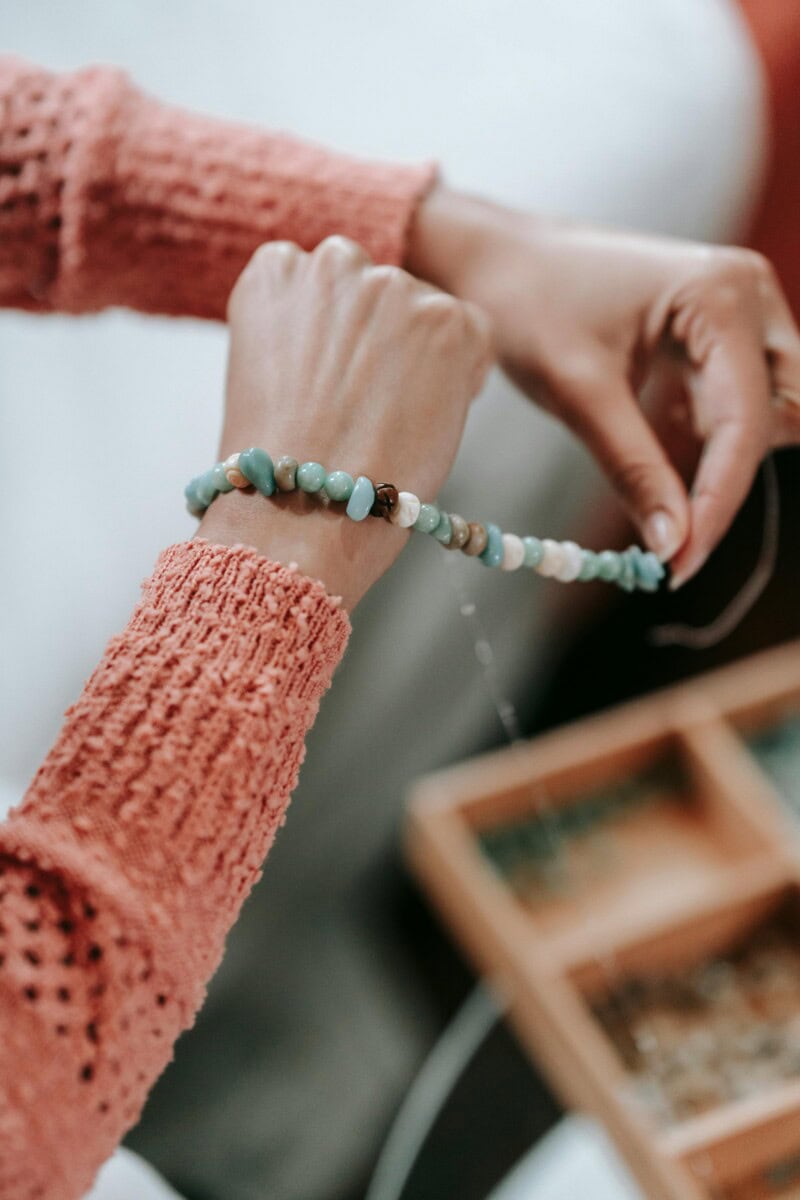
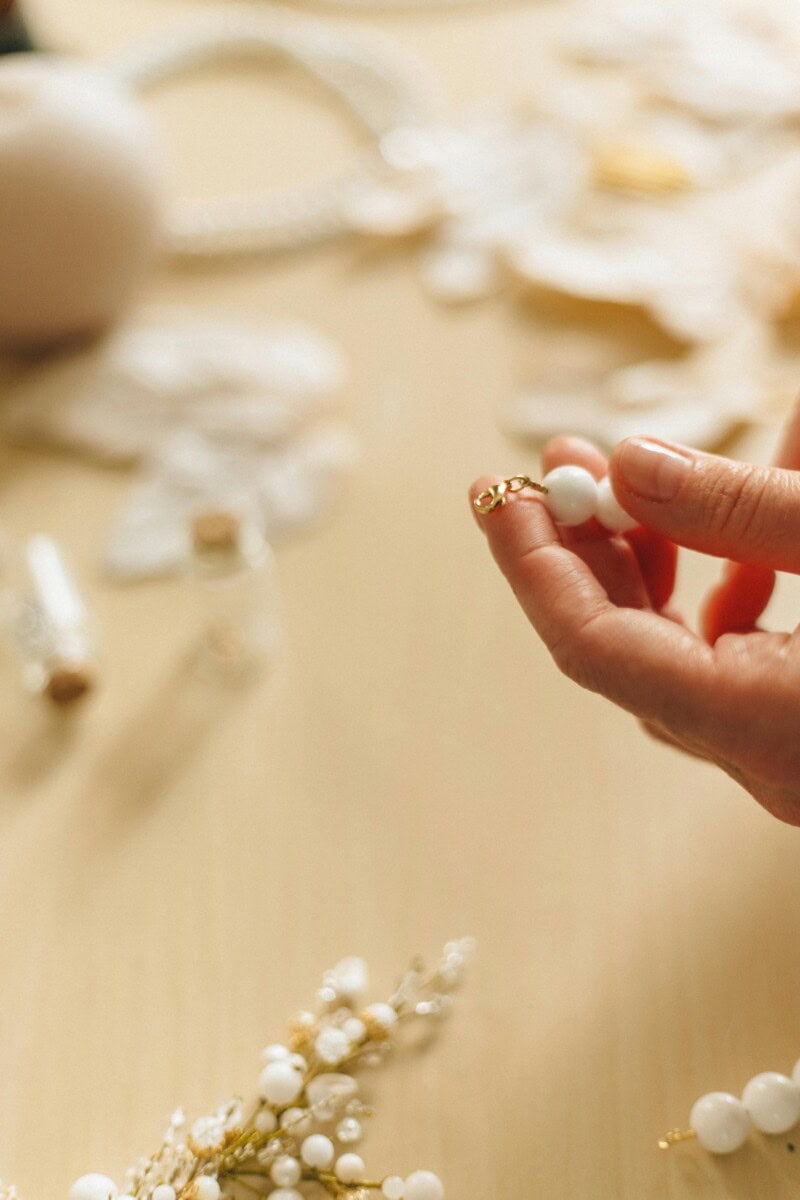
Beyond chevron, countless friendship bracelet ideas await exploration.
Popular pattern styles:
- Heart patterns – Perennially popular for matching bracelets between best friends or couples, strategic knot placement creates heart shapes against contrasting backgrounds
- Diamond patterns – Sophisticated geometric shapes that repeat down the bracelet length, uses combination of all four basic knots
- Zigzags – Bold, energetic designs perfect for high-contrast color combinations
- Arrows – Directional designs pointing up or down
- Geometric shapes – Triangles, hexagons, and complex angular patterns
- Greek key or tribal-inspired borders – Add cultural flair and visual interest
When planning matching sets, consider which patterns work best as matching pairs. Symmetrical designs like chevrons, diamonds, and hearts are natural choices. Some crafters get creative with half-patterns that complete each other—one friend wears the left half of a design while the other sports the right half, and placing the bracelets side by side reveals the full image. These patterns and designs showcase the incredible versatility of simple knotting techniques.
Adding Beads to Your Design
Incorporating beads transforms classic friendship bracelets into something extra special. The key to adding beads successfully is planning their placement before starting the pattern.
Bead placement strategies:
- Beads work best in the middle of the bracelet or at strategic points where they won’t interfere with knotting
- Thread bead onto working strand before making the next knot
- Bead sits between knots, held in place by surrounding string work
- Use beads as accent pieces rather than filling every available space
To add a bead mid-pattern, thread it onto one of the working strands before making the next knot. A pearl bead strategically placed at the center of a chevron point adds elegance, while pony beads scattered throughout create a playful, colorful vibe.
Size considerations:
- Larger beads may need to skip a row to accommodate their size
- Tiny seed beads nestle into the weave almost invisibly
- Match bead holes to string thickness for smooth threading
When creating matching bracelets with coordinating bead placement, consider using the same bead types in the same positions on both pieces—or deliberately vary the placement for complementary rather than identical sets.
Using Letter Beads for Personalization
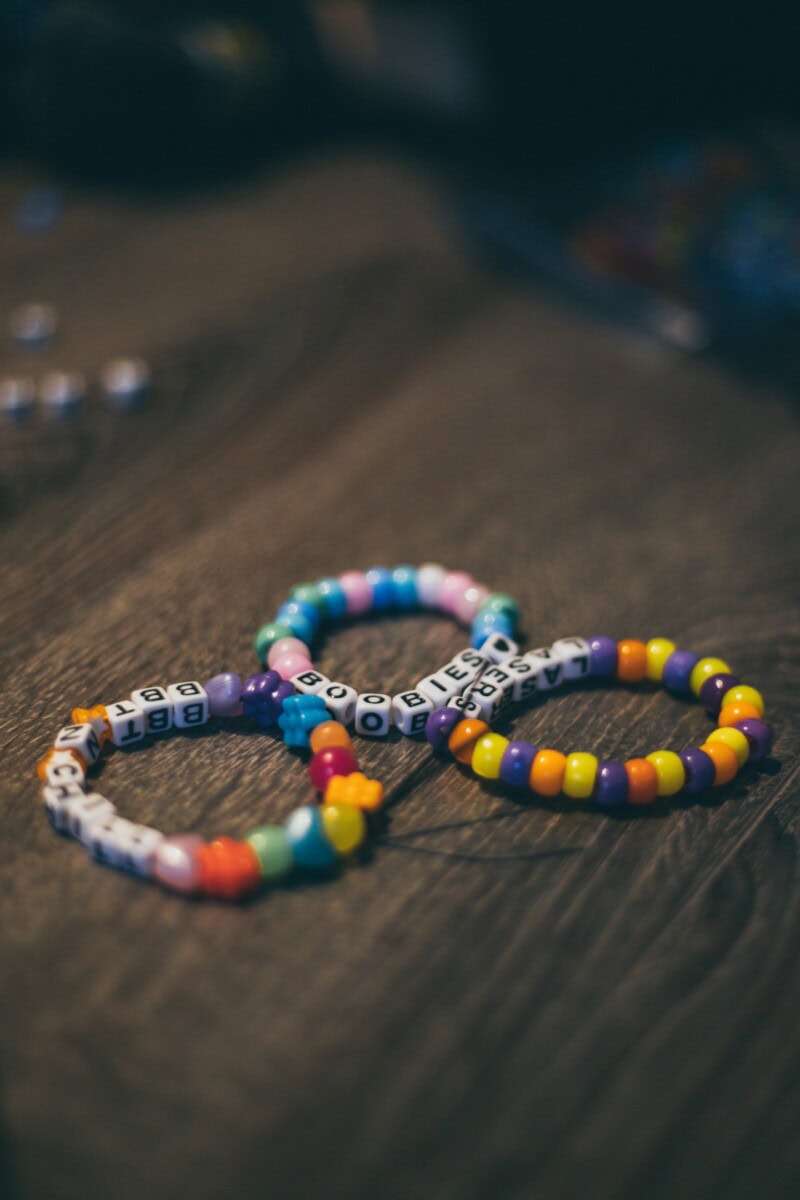
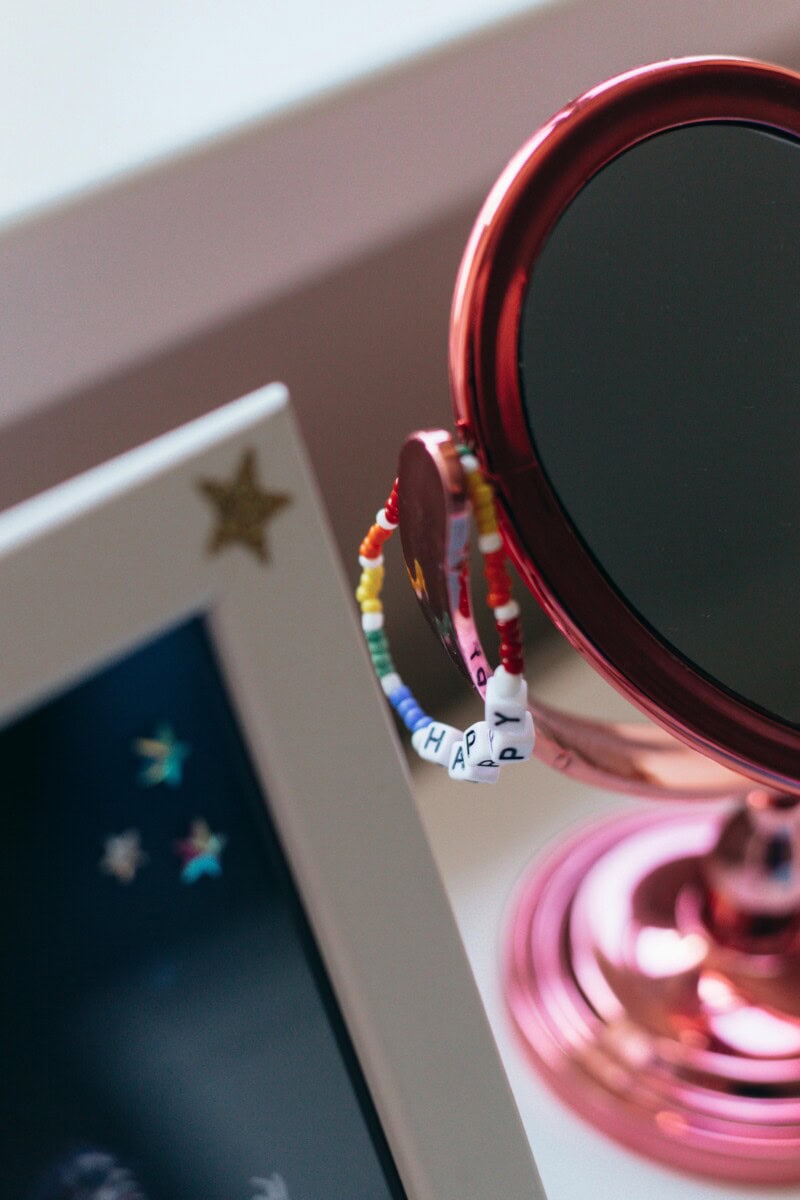
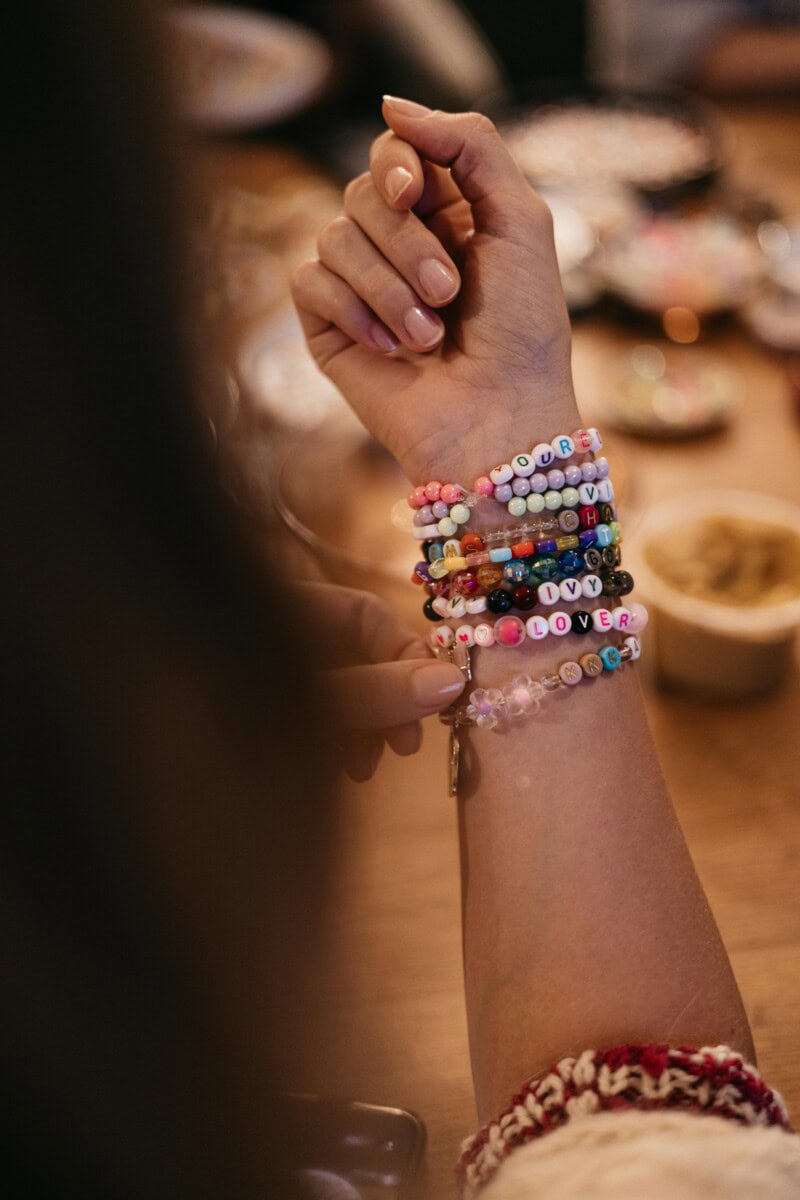
Letter beads take personalization to the next level, transforming a simple bracelet into a meaningful message.
Personalization ideas:
- Spell out a name to make each bracelet unique to its wearer
- Use initials for subtle, sophisticated touch
- Classic “BFF” never goes out of style
- Split messages: “BEST” + “FRIEND”
- Complementary words: “SISTERS” + “FOREVER” or “SUN” + “MOON”
- Use the alphabet creatively for inside jokes or special codes
Creative matching messages add an extra layer of connection. Proper spacing matters when incorporating letter beads. Leave enough room between letters for readability—typically one or two regular knots between each letter bead works well. Center the message on the bracelet for balanced appearance, measuring roughly where the letters should fall before threading them on. This prevents ending up with the word awkwardly positioned near one end of the finished piece.
Favorite Beads: Types and Where to Find Them
The bead world offers endless options, each bringing different aesthetic qualities to bracelet designs.
Bead types and their characteristics:
- Seed beads – Tiny, uniform beads perfect for adding subtle texture and shimmer, countless colors and finishes from matte to metallic to translucent
- Pony beads – Larger, cylinder-shaped with big holes making them easy to thread, ideal for younger crafters or bold, chunky designs
- Letter beads – Various styles from basic white cubes with black letters to colorful options with contrasting text
- Pearl beads – Add sophistication and work beautifully for elegant, dress-up style bracelets
- Glass beads – Catch light beautifully for sparkle and shine
- Wooden beads – Offer earthy, natural aesthetic perfect for bohemian styles
Where to find favorite beads:
- Local craft stores carry basic selections perfect for starting out
- Online retailers offer massive variety and bulk purchasing options
- Specialty bead shops provide unique, high-quality options
- Thrift stores sometimes have vintage bead collections at bargain prices
Budget-conscious crafters can build impressive bead collections without spending a fortune. Variety packs offer sampling of different types without committing to large quantities.
Elastic String Bracelets: Beginner-Friendly Alternative
Not every friendship bracelet requires mastering complex knotting techniques. Elastic string offers a beginner-friendly alternative that’s perfect for quick projects, younger crafters, or anyone who wants beautiful results without the learning curve.
How to make elastic string bracelets:
- Cut a length of elastic cord
- Thread on beads in desired pattern
- Tie ends together with secure knot at the end
- For extra security, tie multiple knots or add clear nail polish or craft glue
- Trim excess elastic close to knot
Simple matching elastic bracelet ideas:
- Alternating color patterns using pony beads
- Name bracelets using letter beads on translucent elastic
- Theme-based designs (ocean colors, rainbow, pastels)
- Matching sets with reversed bead sequences
These easy friendship bracelets work wonderfully as last-minute gifts or quick craft projects for groups. Making a bracelet this way takes minutes rather than hours, making them perfect for parties, classrooms, or rainy day activities. These stretch bracelets slip on and off without clasps or ties.
DIY Friendship Bracelets: Creative Matching Ideas

The world of DIY friendship bracelets extends far beyond identical twins.
Creative matching concepts:
- Twin bracelets – Exact duplicates of same pattern and colors, classic choice that makes a clear statement: we’re a unit
- Mirror-image patterns – Flip the design so bracelets reflect each other, one chevron points down while its match points up, color arrangements reverse
- Complementary themes – Most creative option for matching sets
- Sun and moon designs pair celestial symbols
- Yin and yang patterns embody balance
- Day and night color schemes (bright warm tones vs. cool deep shades)
- Half designs that complete each other – Ultimate symbol of connection, each bracelet shows only part of larger pattern, complete picture emerges when placed side by side
Complementary themes offer perhaps the most creative option for matching sets. This approach requires careful planning but results in truly unique matching bracelets that tell a story about partnership and completion.
Easy Friendship Bracelet Ideas for Quick Projects
Sometimes time is limited but the desire to make bracelets is strong.
30-minute beginner patterns:
- Simple diagonal stripes using one knot type
- Single-color bracelets with beaded accents
- Basic braids with pony beads for instant gratification
Simple matching sets for kids:
- Chunky yarn bracelets with large wooden beads for little hands
- Basic braids interspersed with colorful beads
- Perfect for birthday parties, scout meetings, or classroom activities
Last-minute gift ideas:
- Two-color candy stripe bracelets in recipient’s favorite colors
- Elastic bead bracelets with personalized letter combinations
- Simple braided bracelets with meaningful color symbolism
- Quick chevron patterns using three colors maximum
The beauty of these easy friendship bracelet projects lies in their accessibility. They prove that creating meaningful, handmade gifts doesn’t require advanced skills or hours of time—just a bit of creativity and thoughtfulness. These fun and easy projects deliver stunning results quickly.
Friendship Bracelet Ideas: Beyond Basic Matching Sets
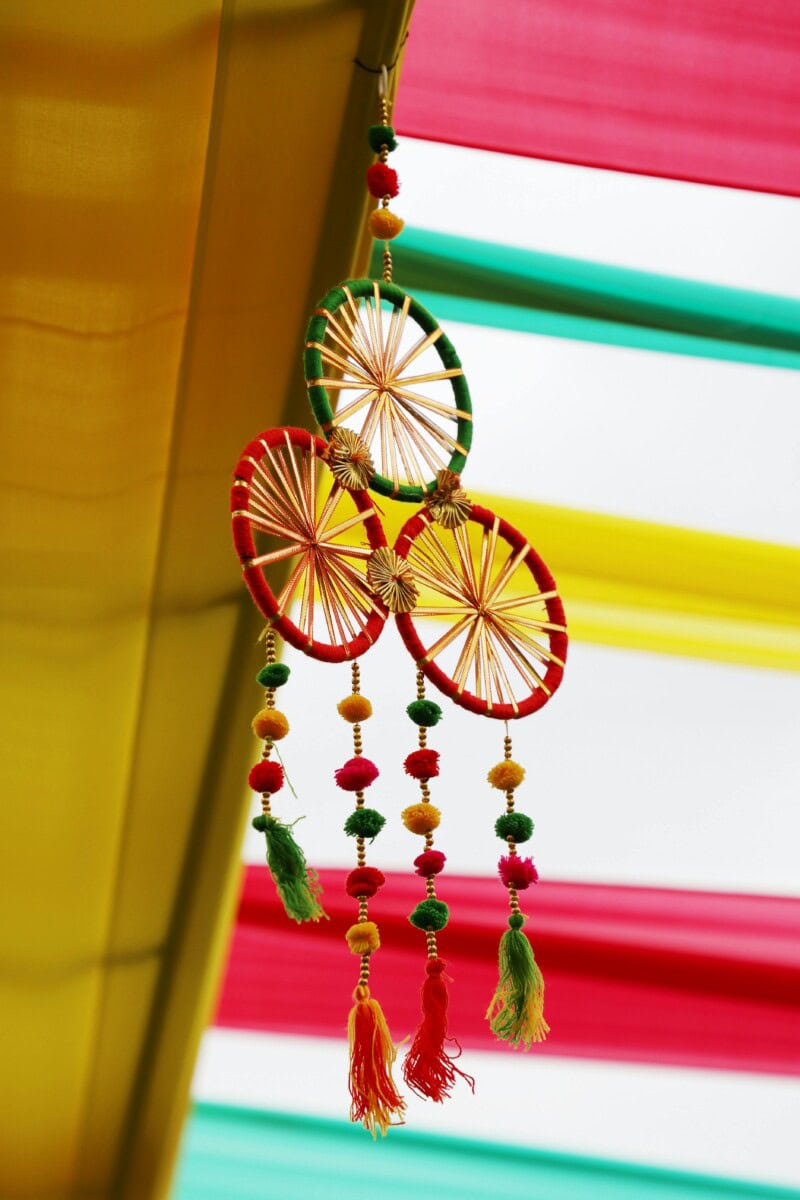
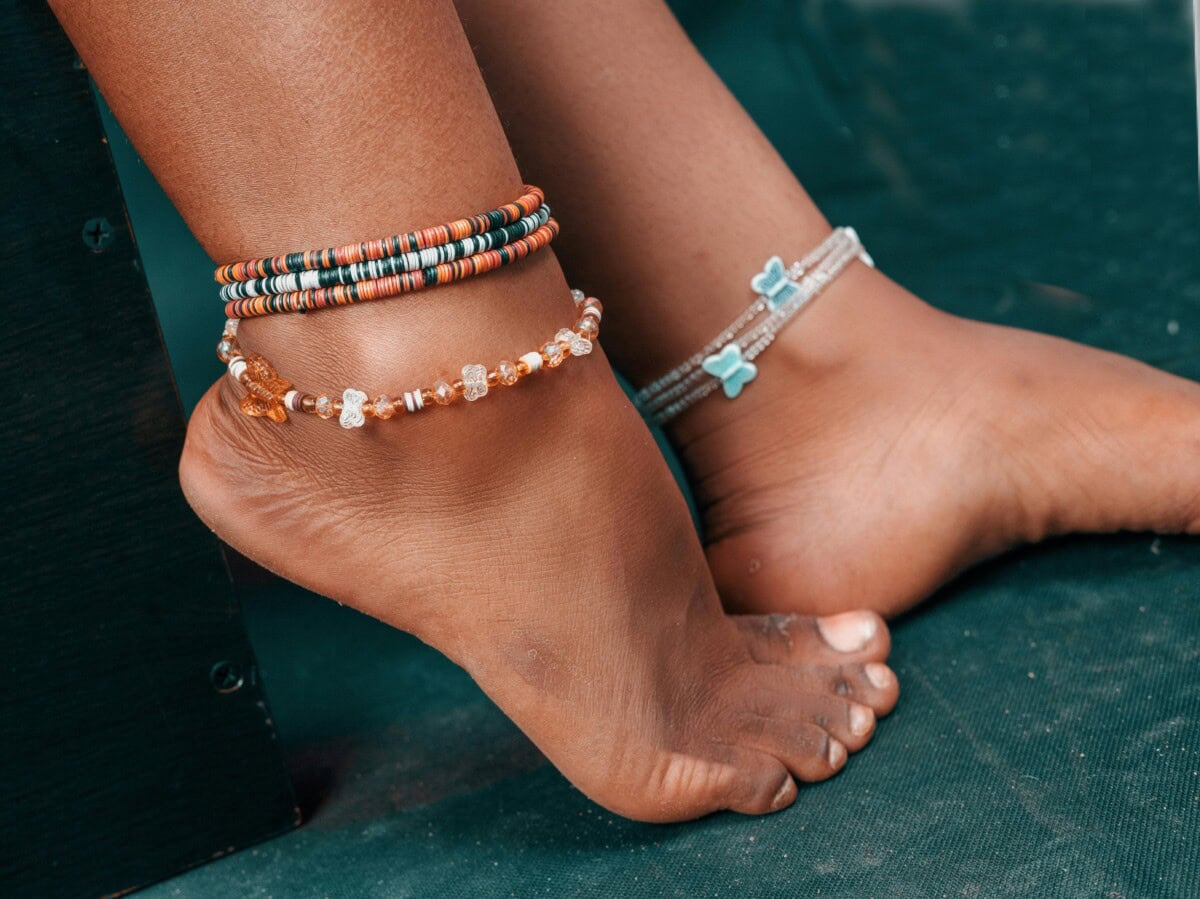
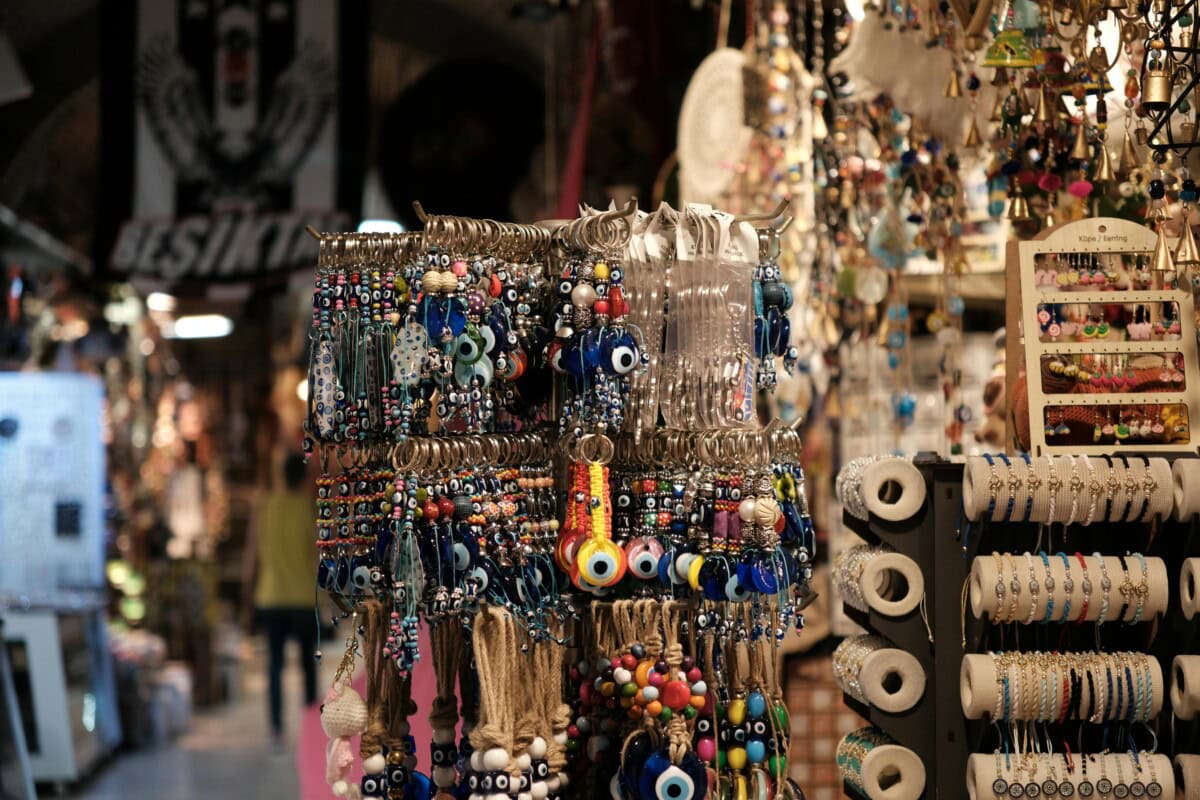
Why stop at wrist bracelets? The same techniques that create beautiful bracelets work equally well for other projects.
Alternative applications:
- Ankle bracelets – Bohemian, beachy vibe perfect for summer, simply make them longer for ankle circumference
- Keychains – Add pop of color to keys or bags while showcasing knotting skills
- Bookmarks – Create long, narrow band and finish off your bracelet with decorative tassel or bead at bottom
- Bag charms – Make shorter bracelet segment and attach to key ring or clip for instant decoration
Coordinated jewelry collections:
- Match a bracelet with corresponding anklet
- Make whole set of bracelets in graduated sizes for stacking
- Create necklaces using bracelet techniques (requires stronger thread)
- Design complete jewelry suite with matching elements
The skills learned making friendship bracelets translate surprisingly well to other jewelry-making projects. Creating classic friendship bracelets opens doors to entire world of fun friendship bracelets and related crafts.
Understanding Friendship Bracelet Knots: Advanced Tips
Once the four basic friendship bracelet knots feel comfortable, it’s time to explore advanced techniques.
Advanced knotting techniques:
- Double knots – Tying two complete knots on each strand instead of standard amount creates extra texture and slightly thicker, more defined bracelet, works especially well with thin thread
- Combining knot types – Alternating forward and backward knots within same horizontal line produces textured appearance different from standard patterns
- Experimenting with combinations – Leads to original designs that stand out from typical patterns
Troubleshooting common tension issues:
- Bracelet curves → Tension is tighter on one side than the other
- Gaps appear → Knots aren’t being pushed up snugly enough
- Band twists → Base strands are rotating during knotting
- Edges look uneven → Outermost knots are being pulled differently than center ones
Maintaining awareness of tension throughout the project prevents these issues. Taking breaks helps too—tired hands unconsciously change tension, so stepping away and returning fresh keeps work consistent.
Learn How to Make Advanced Techniques
Advanced bracelet makers eventually encounter situations requiring special techniques to learn how to make more complex designs.
Advanced technique applications:
- Adding new strings mid-pattern – Necessary when original strand runs out or when intentionally incorporating new color partway through, simply tie new strand onto old strand with small knot, leave tail to weave in later
- Creating shaped designs – Hearts that bulge out or waves that create dimensional effects require manipulating knot placement and adjusting tension deliberately
- Incorporating multiple patterns – Beginning features simple stripe section, transitions into chevron pattern in middle, finishes with different geometric design at end
These techniques take practice but open up three-dimensional design possibilities beyond flat patterns. Planning transitions carefully ensures smooth pattern shifts without awkward gaps or bunching.
Bracelet Making: Tools and Workspace Setup
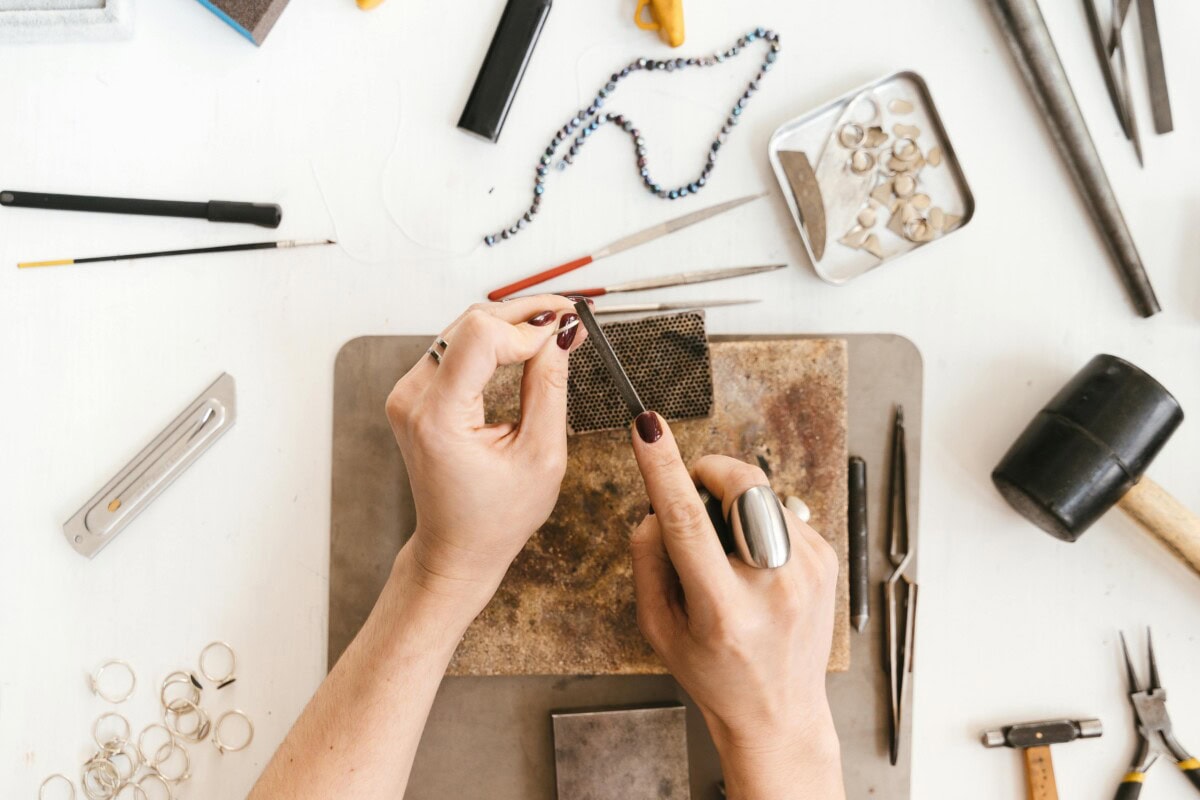
While friendship bracelets can be made with minimal supplies, certain tools make the process easier and more enjoyable for bracelet making.
Essential tools beyond basics:
- Scissors dedicated to craft projects
- Clipboard with strong clip for securing work
- Tape for surface attachment
- Safety pins for alternative securing methods
- Specialized bracelet maker tools with slots or notches that organize strings
Organizing your supplies:
- Store embroidery floss by color in clear containers or bags
- Keep beads sorted by type in small compartments or jewelry organizers
- Maintain dedicated scissors just for bracelet making
- Store patterns in binder or folder for easy reference
Creating a dedicated crafting space:
- Small table or desk with good lighting works perfectly
- Even just a corner of a room makes projects more accessible
- Having everything organized and accessible means spontaneous crafting sessions happen more often
- Projects get finished instead of languishing half-complete
The right workspace setup transforms bracelet making from occasional hobby to regular creative practice.
Video Tutorial Recommendations
Sometimes written instructions aren’t enough—watching someone’s hands form knots in real-time clarifies techniques in ways photos can’t.
Where to find quality tutorials:
- YouTube channels – Specialize in friendship bracelet tutorials from absolute beginner basics to complex advanced patterns, close-up shots from multiple angles show exactly how each knot forms
- TikTok creators – Short video format works well for demonstrating specific techniques (how to finish the bracelet, how to make a forward knot, how to add a bead mid-pattern)
- Platform algorithms – Help discover new pattern ideas and creative variations
When to use video tutorial vs. written patterns:
- Video for learning new knot types and techniques
- Video for visual reference when stuck on confusing step
- Written patterns for following along during actual creation
- Written patterns for quick reference without device distractions
Many crafters use both resources together—watching a video tutorial first to understand overall process, then following written pattern instructions while actually making the bracelet. This combination approach provides both understanding and practical guidance.
Make Friendship Bracelets: Complete Project Ideas
Putting all these skills together, here are complete project ideas to make friendship bracelets at every skill level.
Beginner-friendly matching set project:
- Choose three-color candy stripe pattern using favorite colors that coordinate
- Cut six strands total (three of each color), each about 30 inches long
- Tie them together leaving 2-inch tail, secure to workspace
- Begin making forward knots across each row
- Continue until bracelet measures 6-7 inches
- Braid remaining strands and tie off
- Repeat process for second matching bracelet
- Time investment: 45 minutes per bracelet for beginners
Intermediate challenge pattern:
- Classic chevron in four colors
- Requires comfort with both forward and backward knots
- Use eight strands total (two of each color) arranged symmetrically
- Work from outside edges toward center, meeting in middle for each chevron point
- Typically takes 1-2 hours
- Results in stunning bracelet perfect for matching sets
Advanced coordinated designs:
- Complementary diamond patterns where one bracelet features diamonds on solid background while its match shows solid diamonds with negative space
- Requires careful color planning and consistent tension
- Produces museum-quality results that look professionally made
Finish the Bracelet: Proper Ending Techniques
How a bracelet is finished determines both its appearance and longevity.
Ending techniques:
- Braided ending – Simplest technique, braid remaining strands into three-strand braid, tie off with overhand knot, creates secure closure that ties around wrist, start bracelet with similar braided section for symmetry
- Adding clasps – More polished, adjustable closure system, small lobster clasps or barrel clasps from jewelry supply stores attach to bracelet ends using jump rings, works especially well for matching bracelets intended as formal gifts
- Adjustable sliding closure – Best of both worlds with professional appearance and easy adjustability, uses two additional strands to create sliding knot system around main bracelet ends, wearer can tighten or loosen by sliding knots along base strands
To finish off your bracelet with any method, ensure all knots are secure and trim excess string neatly. For extra durability, a tiny dot of clear nail polish or fabric glue on the final knot prevents it from coming undone over time. Get your bracelet looking its absolute best by gently evening out any knots that seem loose or uneven before calling the project complete. Finish your bracelet with care and attention to detail for lasting results.
Ready to Make Your Matching Friendship Bracelets
The time has come to start that first project! Choosing a first pattern as a pair requires honest assessment of current skill level.
Getting started successfully:
- Don’t jump straight to complex designs—build confidence with simpler patterns first
- Candy stripe or basic chevron patterns are excellent starting points
- Look impressive while remaining accessible
Time management for projects:
- Simple pattern: 30-45 minutes for beginner
- Complex designs: 2-3 hours or more
- Set realistic expectations to prevent rushing
- Work on both matching bracelets in parallel for consistent tension
Starting your matching set today:
- Gather supplies and dive in
- Remember every expert started exactly where beginners are now
- Initial challenges with tangled strings, uneven tension, and wrong-direction knots are normal
- Practice makes progress
The beauty of friendship bracelets lies not in perfection but in the love and effort poured into each one.
These handmade creations carry meaning far beyond their simple materials. They represent time invested, thoughtfulness, and the special bond between friends, partners, or family members. Whether crafted for summer camp traditions, birthday gifts, or just because, matching bracelets become treasured keepsakes that outlast trends and fads.
The simple act of weaving and tying creates something meaningful. Each knot represents a moment of care, each color choice reflects knowledge of what someone loves. Making bracelets for others—and getting your bracelet from someone who made it by hand—creates connections that transcend the physical object itself.
Key Takeaways: Your Friendship Bracelet Journey
Master the fundamentals:
- Learn the four basic friendship bracelet knots: forward, backward, forward-backward, and backward-forward
- Practice consistent tension for professional-looking results
- Understand how to read friendship bracelet patterns using grid systems and symbols
- Master basic knots before progressing to advanced techniques
Gather proper supplies:
- Choose between embroidery floss (classic), yarn (chunky), or elastic string (easy)
- Stock up on various bead types: pony beads, pearl beads, letter beads, seed beads
- Organize workspace with clipboard, scissors, tape, and storage containers
- Select friendship bracelet colors thoughtfully for coordinating matching sets
Start with beginner patterns:
- Candy stripe uses only forward knots for simple diagonal design
- Three-strand braid requires no knotting—perfect for absolute beginners
- Simple striped pattern teaches backward knots
- Chevron pattern introduces working from both sides simultaneously
- These easy friendship bracelet and easy friendship options build confidence quickly
Advance your skills progressively:
- Learn how to make chevron friendship bracelet as intermediate challenge
- Practice reading friendship bracelet patterns to expand design options
- Explore diamond friendship bracelet pattern for geometric sophistication
- Master friendship bracelet knots including double knots and combination techniques
- Try adding beads at strategic points throughout design
Create meaningful matching sets:
- Design twin bracelets (identical) or mirror-image patterns (complementary)
- Use letter beads to spell coordinating messages across matched pairs
- Try complementary themes like sun/moon or day/night color schemes
- Experiment with half-patterns that complete each other when placed side by side
- Consider making matching bracelets for family members or friend groups
Perfect your finishing:
- Finish the bracelet with braided endings, clasps, or adjustable sliding closures
- Tie secure knot at the end and seal with clear nail polish for durability
- Create desired length by measuring carefully before starting
- Finish your bracelet with attention to detail for polished results
Personalize creatively:
- Add letter beads to spell name, initials, or meaningful words using alphabet
- Incorporate favorite beads including pearl beads for elegance
- Try adding beads at middle of the bracelet for focal point
- Use elastic string for quick, clasp-free stretch designs
- Experiment with string on the left and string on the right for pattern variations
Expand beyond basics:
- Apply skills to ankle bracelets, keychains, bookmarks, and bag charms
- Create fun friendship bracelets and classic friendship bracelets for various occasions
- Make bracelets as gifts, for summer camp, or for preschool craft activities
- Try diy friendship and diy friendship bracelets projects for creative exploration
- Build complete coordinated jewelry collections
Use helpful resources:
- Watch video tutorial content for visual learning of complex techniques
- Follow patterns and designs from online bracelet maker communities
- Reference friendship bracelet ideas for inspiration when starting new projects
- Learn different string for friendship bracelets options and when to use each
- Join online communities to share handmade creations
Remember the essentials:
- Making a bracelet requires patience and practice—perfection isn’t the goal
- Each bracelet represents time, care, and meaningful connection
- Start simple and progress gradually to avoid frustration
- Tie a knot in friendship that lasts beyond the physical bracelet
- Ready to make your first set? Gather supplies and begin today!
The journey from beginner to confident bracelet maker happens one knot at a time. With practice, patience, and creativity, anyone can create beautiful matching friendship bracelets that celebrate meaningful connections. The weave of each strand, the careful tie of each knot around another, and the simple joy of making something with one’s own hands transforms basic embroidery floss or yarn into treasured tokens of connection. Whether creating simple braided bands or intricate patterns, whether using a basic braid or advanced floss techniques, the act of bracelet making brings people together. Now it’s time to gather some thread, pick a pattern, and start creating something special!
FAQs
How do I make a friendship bracelet using different strands?
To make a friendship bracelet, you will need several strands of embroidery floss or yarn. Start by cutting the strands to your desired length, typically around 24 inches each. You can choose to use multiple colors for a vibrant design or stick to a single color for a classic look. Once you have your strands, tie them together at one end and secure them with a clip or tape to keep them in place while you work.
What materials do I need to make a friendship bracelet?
To create a friendship bracelet, you will need embroidery floss or yarn, scissors, and a clipboard or tape to hold your work in place. Optional items include beads for added decoration and a ruler to measure the strands accurately. The type of thread you choose can affect the look and feel of your bracelet, so consider using cotton or polyester blends for durability.
Can I personalize my friendship bracelet with names?
Yes, you can personalize your friendship bracelet by incorporating names or initials into the design. This can be done using letter beads or by creating a pattern that represents the initials. If you are skilled in knotting, you can even craft letters using the strands themselves in a more intricate design.
What are some popular patterns for friendship bracelets?
Popular patterns for friendship bracelets include the classic chevron, simple braid, and the more complex diamond or spiral patterns. Many tutorials are available online that can guide you through these patterns, often featuring step-by-step instructions to help you master the techniques needed for each style.
How do I finish my friendship bracelet once I’m done?
To finish your friendship bracelet, tie a secure knot at the end of your design. If you have used multiple strands, it is helpful to tie them together at the end to prevent unraveling. You can then trim any excess thread, leaving a small tail if you wish to add a clasp or simply tie the bracelet on your wrist directly.
What is the best way to wear a friendship bracelet?
Friendship bracelets are typically worn on the wrist, but you can also wear them as anklets or even as hair accessories. The best way is to tie the bracelet securely on your wrist, allowing it to sit comfortably without being too tight. Many people enjoy wearing multiple bracelets at once for a layered look.
How do I care for my friendship bracelet?
To care for your friendship bracelet, avoid exposing it to water or harsh chemicals, as this can weaken the strands and alter the colors. If it becomes dirty, gently clean it with a damp cloth. Storing your bracelet in a dry, cool place will also help maintain its appearance and longevity.
Can I make a friendship bracelet with only one strand?
While friendship bracelets are typically made using multiple strands for texture and color, you can create a simple bracelet using just one strand. This can be achieved by wrapping the single strand around your wrist, tying knots as you go to create a unique design. It may not have the same complexity, but it can still be a charming accessory.
You might also be interested in…
Looking for other crafts to make with your family? Check out this link to Creative DIY Jewelry Making Ideas: Easy and Fun Jewelry Craft Projects to Try This Fall!
CONNECT WITH DAILY MOM
💖 NEWSLETTER: DAILY READS IN YOUR INBOX 💖
Sign up to receive our picks for the best things to do, see and buy so you can relax and focus on more important tasks! Let us help you be the best version of yourself you can be!
BE SOCIAL WITH US
📌 LOVE IT? PIN IT!📌
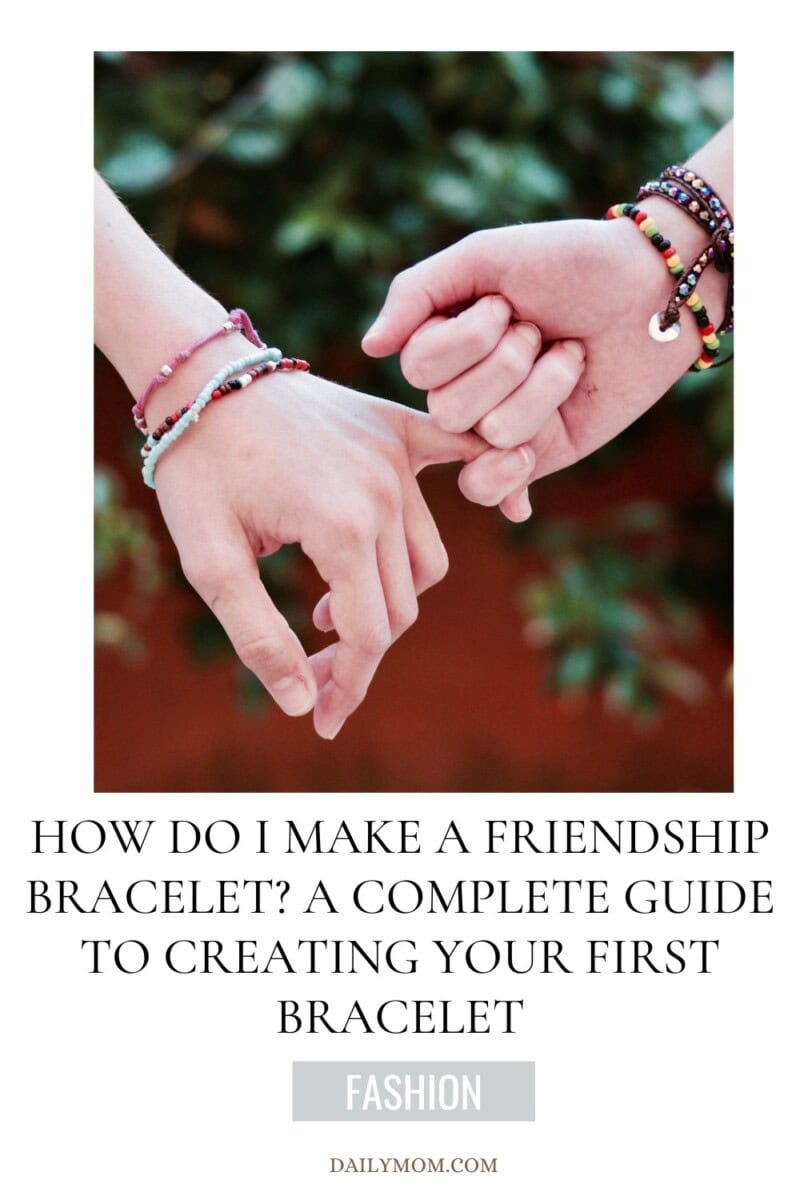
Photo Credit – Pexels